Oblong x Giorgetti Spiga 2026: A Curated Artworks Selection during Milan Design Week

During Milano Design Week 2026, Oblong Contemporary presents an extended selection of artworks at Giorgetti Spiga – The Place in Milan, where contemporary art enters into a precise and considered dialogue with architecture, design, and material research.
Conceived as an integrated presentation rather than a traditional exhibition, and curated by Oblong Contemporary in collaboration with Giancarlo Bosio, Creative Director of Giorgetti, the selection unfolds across the interiors of the historic residence on Via della Spiga, where each work is positioned in direct relationship to space, light, and proportion. Within this context, sculpture and painting are not treated as autonomous objects, but as active elements that shape the perception of the environment.
At the core of the presentation are the works of Stefano Bombardieri, whose sculptural language investigates weight, suspension, and existential tension. His practice is rooted in a deep reflection on balance — both physical and symbolic — where mass appears simultaneously grounded and unstable. Works such as Balancing on the Past 4 (2021), La forma e il contenuto lucido (mini) (2024), and La forma e il contenuto nero (piccolo) (2024) articulate this duality through bronze, while Tutto andava a fuoco (2020) introduces a more conceptual dimension, combining material transformation with a sense of contained fragility.
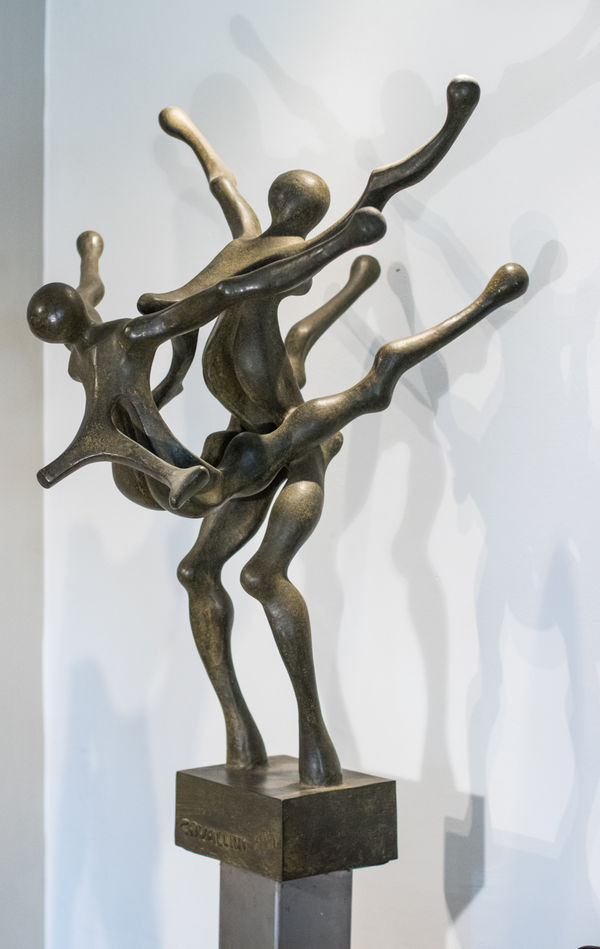
In dialogue with Bombardieri, the works of Sauro Cavallini bring a distinct expressive intensity. Cavallini’s sculptural practice is defined by movement and emotional force, where figures and animals are captured in moments of tension and release. From the dynamism of Passo di danza (1979) and Ballerina (1981), to the powerful presence of Cavallo con criniera e coda, his works translate gesture into form. Complementing the sculptures, works on paper such as Passo a due in volo (1977) and Cavallo eretto (1969) reveal the immediacy of his line and the foundational role of drawing in his practice.
A more subtle and material-driven approach is introduced through Candida Ferrari, whose works in plexiglass and acrylic investigate transparency, light, and spatial layering. Pieces such as Luce trasparente (2026) and COSE RITROVATE (2000) operate through restraint, where minimal intervention produces a refined visual tension. The works shift depending on light conditions, creating a constantly evolving perception that is both delicate and precise.
The exploration of surface and structure continues with Omar Ludo, whose Estroflessione bianca grande (2022) expands the pictorial plane into a sculptural dimension. The work moves beyond traditional painting, where the canvas itself becomes a three-dimensional object, emphasizing volume, rhythm, and repetition.
A central role within the presentation is held by Fiedler O Mastrangelo, whose practice navigates between architecture, abstraction, and material experimentation. The large-scale Topografie triptych (2026) establishes a spatial rhythm through layered surfaces and gestural marks, while works such as Solomon Chopsticks (2024) — executed in Murano glass and forged steel — introduce a complex dialogue between fragility and structural precision. Sculptural works including Pillars of Creation (2024) further reinforce this interplay between mass and lightness, solidity and transformation.
The sculptural narrative is extended by Nicola Salvatore, whose Il carro degli idei (2009) reflects a more symbolic and narrative approach, rooted in classical references yet articulated through a contemporary lens.
In contrast, Umberto Ciceri’s HYPERTRAIT QUALIA (2014) introduces a conceptual investigation of perception and image, combining optics, photography, and layered materials to question the nature of representation.
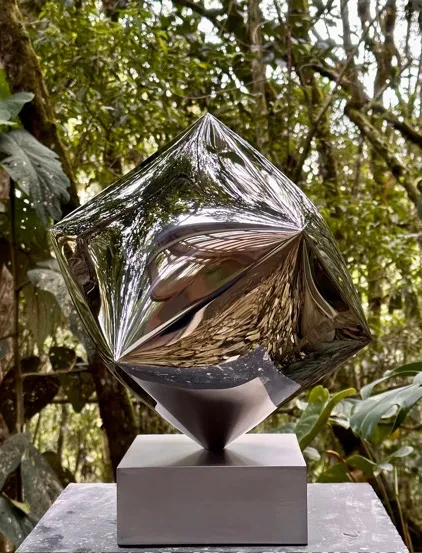
Completing the selection, Gustavo Vélez presents Expansión Geométrica II (2023), a work that exemplifies his internationally recognised approach to geometric deformation. In Vélez’s practice, rigid structures appear to bend and expand, creating the illusion of movement within static material, and transforming geometry into a fluid, almost organic presence.
Across the presentation, a unifying thread emerges: a continuous negotiation between weight and lightness, structure and fluidity, permanence and transformation. Each work contributes to a broader narrative where contemporary art is not isolated, but embedded within the experience of space.
This approach reflects Oblong Contemporary’s ongoing commitment to placing artworks within lived environments — where sculpture and painting become part of a larger architectural and cultural context.






 W: +39 3357055914